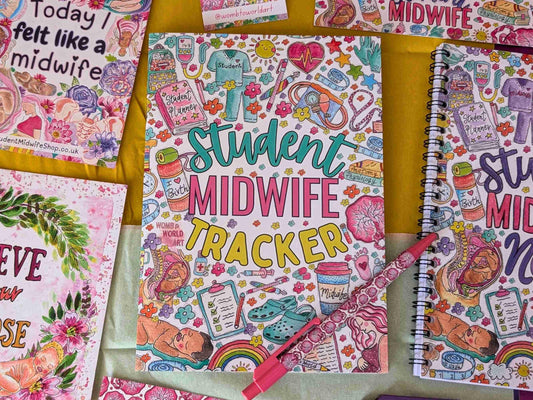
How to Keep Track of Student Midwife Life: PERs, Proficiencies & Shifts

If you are a student midwife, you know that degree training is a massive juggling act. Between navigating 12-hour placement shifts, meeting academic deadlines, logging clinical requirements, and managing life outside of the hospital, staying on top of everything can feel overwhelming.
Want a creative way to track your 40 births in breaks? I’ve put together an illustrated Free Printable Colouring Birth Counter featuring a 1-to-40 countdown surrounded by my artwork. It’s free to download in my shop - grab your copy, print it out for your desk, and enjoy a little mindful colouring on your journey to becoming a midwife!

When you're running between bays, facilitating births, and delivering postnatal care, finding a computer to log every single check on eMORA in real time is almost impossible - and pulling out your phone on the ward isn't always practical or appropriate. To stop themselves from feeling buried in paperwork, many students end up making their own makeshift systems, from taping handmade tally sheets to placement folders to sticking post-it notes all over their desks.
Seeing these DIY solutions inspired me to create practical, beautiful tools that keep student midwives calm, confident, and 100% compliant throughout their training. Whether you're mapping out your academic year from home or tracking your 40th birth milestone on shift, here is how you can break your workload down into manageable layers so you can focus on what matters most: becoming an amazing midwife!
Jump to section:
- How to Track Shifts and Placements
- How to Keep Track of Plans on the Go
- How to Track Proficiencies and Practice Episode Records
- What's included in my student midwife tracker
- How to Use Your PERs Tracker
- How to track your proficiencies safely (without a Pocket eMORA)
- How to Track Your 40 Births at Home and On Shift
How to Track Shifts and Placements
Midwifery training moves fast, and losing track of shift rotations or upcoming essay deadlines is easy when you're exhausted after a long placement block. Having a clear, visual overview of your year right in your study space makes a world of difference.
Practical Tip: At the start of each academic year or term, block out your placement rotations in one bright color, campus days in another, and explicitly mark off "zero-work rest days." Seeing your year mapped out macro-style prevents burnout and helps family members or housemates understand your erratic shift schedule at a glance!
"This wall planner is stunning and an absolute necessity for getting started as a student midwife. I have all my days on campus and assessments all written up and I see it every day which helps! Beautiful artwork!" - Hayley

My Student Midwife Academic Wall Planner gives you a complete year-at-a-glance layout designed specifically for training schedules - and helps family members know where you'll be:
- Dedicated Sections: Features custom areas to log placement blocks, university campus days, assessment due dates, and general notes.
- Visual Clarity: The sticker dots help you colour-code your shift blocks, plan study days ahead of time, and schedule well-deserved rest days so you never get caught off guard.
- Illustrated Details: Framed with hand-drawn birth illustrations, affirmations, and clinical icons to brighten up your study space.
"I had been searching for one as my daughter is due to start midwifery at uni in September. Wanted something to not only brighten up her room……… but something that would work for her when she went on placements or have assignments etc to hand in. This has got room to note everything down~ and comes with stickers etc to flag important deadlines. It starts in September ~ whereas some online started in January." - Lisa

How to Keep Track of Plans on the Go
While a wall planner is fantastic for your study space at home, you also need a portable companion to keep track of your weekly schedule, placement areas, and reflection debriefs wherever you go.
Practical Tip: Use a portable planner to jot down mentor contact details, placement ward phone numbers, and quick reflection points right after a tough shift. Taking 2 minutes to debrief on paper before heading home helps you process your day and switch off!
My hand-illustrated Student Midwife Planner Notebook is an A5 weekly academic planner designed specifically for your training journey:
- Placement & Assessment Trackers: Dedicated pages to record placement areas, mentors, shift dates, and assessment deadlines all in one place.
- Weekly Spreads & Reflection Pages: Covers 12 full months with weekly layouts, monthly overviews, and built-in reflection space for debriefs, notes, or self-care reminders.
- Durable & Practical: Spiral-bound to lay completely flat on your desk, with a durable gloss-laminated cover and thick 150gsm uncoated paper that easily holds highlighters without bleeding through.

How to Track Proficiencies and Practice Episode Records
If you are a student midwife on placement, you likely know the chaotic reality of keeping track of your proficiencies and Practice Episode Records (PERs). Between running between bays, facilitating births, and delivering postnatal care, finding a computer to log every single check on eMORA in real time is almost impossible - and pulling out your phone on the ward isn't always practical or appropriate.

"what me and a few friends had to do is a tally sheet stuck to the back of my folder to track my antenatal checks, postnatal checks, neonatal checks, births and NIPEs."
I noticed this struggle when chatting with student midwives online. To stop themselves from feeling overwhelmed, many students end up making their own makeshift tally sheets and taping them to the back of their placement folders just to get a visual overview of where they stand with their numbers.
"People absolutely rave about pocket trackers... I just know you’d get a tonne of interest if you made a little tracker to keep in a folder!"
Seeing these DIY trackers sparked an initial idea: Why not create a cute pocket proficiency log book, like a portable eMORA booklet?

I started looking into the idea as I could see a lot of other people have made them, but after speaking with students and finding out official guidelines, I realised it wasn't the right path. The NMC's eMORA is a protected framework, and reproducing official competencies or assessment text in a commercial booklet creates copyright issues and risks causing confusion if local university guidelines differ.
I found out that the NMC explicitly advises students against using third-party pocket eMORA guides. Making things to support students with authenticity and credibility is my top priority, so I chose to leave official log booklets!
Instead, I made something students could use on the shift floor: a quick, visual tally system that keeps you motivated without breaking any rules.

That is how my PERs Tracker Booklet was born! Designed as a slim, lightweight booklet, it easily tucks into the pocket of your placement folder or slips seamlessly into your shift bag so you can update it the second you finish care.
"I recently got one of the proficiency trackers from The Student Midwife Shop, and it shocked me actually seeing my progress right in front of me in such a cute format, making me realise how much I’d underestimated myself." - Lou

What's included in my student midwife tracker & why you need to track them
Every grid in the booklet is tailored to the core requirements student midwives must log during their training to demonstrate clinical competence before qualifying:
- Antenatal Examinations (Grid of 100): Tracking your antenatal appointments helps build confidence in abdominal palpation, auscultating fetal heartbeats, blood pressure monitoring, and assessing maternal well-being throughout pregnancy. Pro tip: Don't wait until Year 3 to start logging antenatals - colour in every check from Year 1 so you don't end up scrambling near qualification!
- Postnatal Examinations (Grid of 100): Logging postnatal checks ensures you gain hands-on experience evaluating maternal recovery, uterine involution, perineal healing, emotional health, and early bonding after birth.
- Newborn Examinations (Grid of 100): Tracking these routine checks allows you to practice assessing infant wellness, weight, jaundice levels, feeding progress, and vital signs in those crucial first days of life.
- Births Attended (Grid of 40): A crucial milestone requirement! Tracking 40 births ensures you actively facilitate care throughout labour, delivery, and the third stage across different birth settings. Advice: Count every delivery setting - community home births, birth centers, and consultant-led units all add up to your 40!
- NIPE Examinations: The Newborn and Infant Physical Examination (NIPE) is an advanced skill checking the baby's eyes, heart, hips, and testes within 72 hours of birth. Because NIPE targets vary between universities and cohorts, this section has a blank target box so you can set your specific requirement.
- Infant Feeding Support: Dedicated space to track your required targets for supporting mothers with breastfeeding, express routines, or formula feeding.
- 3 Blank Customizable Trackers: Because different universities or placement trusts set custom targets (such as Continuity of Carer caseloads or specific skill sign-offs), three blank grids are included so you can set your own targets!

How to Use Your PERs Tracker
- Colour It In As You Go: Use highlighters or coloured pens to fill in or cross out a box every time you complete a check or facilitate a birth. Choosing different colours for different placement blocks or months makes your progress pop off the page!
- Record Your Completion Dates: Each section includes a space at the bottom to write down the exact date you completed all 100 checks or hit your 40th birth milestone.
- 100% Compliant & Safe: It uses pure numbers and visual tally grids - zero official NMC wording or copyrighted text - making it completely safe to use alongside your official digital logging system.
- Satisfying Visual Progress: Watching those colourful blocks fill up shift by shift gives you an instant morale boost and keeps your remaining targets crystal clear.

How to track your proficiencies safely (without a Pocket eMORA)
If you can’t use a third-party pocket eMORA booklet, how do you actually keep track of complex clinical proficiencies while running around on placement?

If you don't want to carry official competency wording in a commercial booklet, the trick is finding simple, personal workarounds that keep you organized on shift:
- Use a checklist pad to keep track of your priorities: The idea for my Checklist Pads came directly after a student midwife told me that she spent time every week writing out post-it notes with the specific proficiencies she wanted to get signed off during her upcoming shifts. She asked if I could make a dedicated tool to help her organise her goals. Advice: Before every shift, write down 1–2 key skills (like catheter care or manual BP) on a pocket note. Mentors love when students show up with clear shift goals!
- Use the Official Mobile App: Most modern eMORA systems (like PebblePad’s PebblePocket app) allow you to draft entries offline on your phone during quiet moments or breaks, which sync directly to your official portfolio when you're back on Wi-Fi.
- Keep a Small "Shift Index" Notebook: Carry a plain, unbranded A6 notepad in your tunic pocket. Jot down the date, quick anonymized clinical notes, and the specific skill number or topic (e.g., "12/05 - Manual BP, catheter care - Mentor: Sarah") so you can easily type up the full eMORA reflection when you get to a computer.
- Color-Code Your PERs Tracker: Use the blank customizable grids in your PERs Tracker Booklet to assign specific numbers or colours to key proficiency categories (like medication administration, suturing observation, or emergency skills).
- Review Your Portfolio Before Shift: Check your digital eMORA before your placement block starts and pick 2–3 specific proficiencies to focus on for the week. Knowing exactly what you need to target means you won't need to scroll through pages of competencies while on the ward.
By keeping your official text on the university-approved software and using a visual tally tracker for your numbers, you get the best of both worlds: complete NMC compliance and total peace of mind on placement.
If you buy my student midwife milestones deck you can also celebrate reaching these milestones with some of my cards!

How to Track Your 40 Births at Home and On Shift
In addition to logging your required numbers in your PERs Tracker Booklet, hitting your 40-birth target is a huge milestone that deserves to be celebrated visually along the way!

Many student midwives find that having a physical display in their study space or home gives them a huge boost of motivation during long placement blocks:
Having a bright, visual reminder of every baby you’ve helped bring into the world provides an incredible boost of motivation during long, exhausting placement blocks. The birth counter prints and matching sticker sheets are designed in two formats so you can track your journey wherever suits your routine best:
- A4 Folder Print + Numbered Baby Stickers: Sized perfectly to pop straight into a clear pocket at the front or back of your placement folder. Pair it with the sheet of 40 numbered baby stickers so you can place a sticker onto your chart the second you finish facilitating a birth on shift!
- A3 Study Space Print + Coloured Nappy Baby Stickers: A larger statement art print designed to display proudly on your wall or desk space at home. Match it with the colourful nappy baby stickers to build a vibrant, artwork-style display of your progress every time you get home from a delivery suite shift.
By combining practical tally tracking with visual milestones, you make counting down to your 40th birth an exciting, memorable part of your training!

Find more ideas to make student midwife life easier with my student midwife starter collection