Day in the Life of a Student Midwife: Clinical Skills
Getting hands-on with models and knitted breasts, first-year student midwife Ella shares what a clinical skills day really looks like, how to prepare, and why cohort besties (and ice cream breaks!) are essential.

Getting Ready & Gearing Up
Q. What’s the vibe and energy like on a clinical skills day compared to sitting in a lecture hall?
The energy is totally different! A skills day means that we can go out into practice with this skill under our belt, able to perform it under supervision. Our theory days consist of learning the fundamentals of these skills, even if we are all raring to try them.
With midwifery being such a hands-on profession, I think most of our cohort enjoy these days the most knowing how important they are to improve in practice and as student midwives.

Q. How do you prepare mentally before stepping into uniform for a hands-on practical session?
Before my skills days, I try to make sure I’ve been over the theory side of the clinical skills we will be practicing, as it makes it so much easier to understand why you are doing it and when it’s necessary. We are really lucky to have amazing lecturers who are supportive with our learning, so skills days don’t feel so daunting!
Q. Do you always have clinical skills sessions in the same place and with the same people? Or do you have different teachers for different things? Is it at the university that you practice or in a clinical setting?
We are very lucky to have some amazing resources to help with our practice, including our own healthcare-dedicated building which consists of 'Ward' setups, lecture rooms, skills rooms, and even a room set up to look like a living room/bedroom!
We have arms which can be set up to take blood from when practicing Venepuncture, and a vaginal examination station which can have altered dilation, effacement, etc.
This means we can use these rooms depending on which skill we will be practicing, and the great thing is it’s never the same lecturer teaching us, meaning that you get a wide variety of different experiences and skills to learn.

Q. What do you pack in your bag for a day of skills practice?
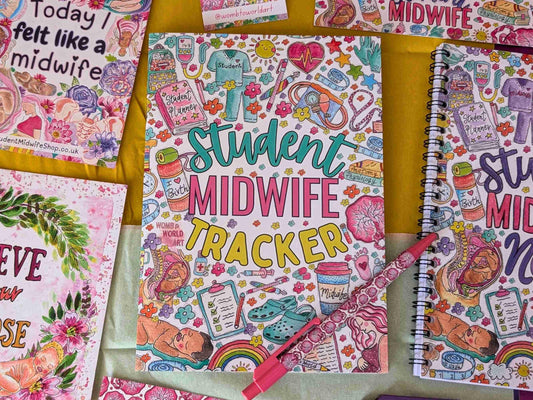
Packing is a serious job when you’re a student midwife because there is so much you need! I take a range of pens (my favourite is from your student midwife pens!), a large water bottle to stay hydrated, especially in recent heat!
My laptop for note-taking if needed unless we are hands-on all day, and my student midwife planner so I can check what the day entails.

Hands-On in the Skills Lab
Q. Could you share a bit about how you practice each skill/why you need that skill as a midwife, and what equipment you use?
Venepuncture
As students, we are required to learn how to practice venepuncture safely on the people we are looking after, for reasons such as routine antenatal screening, urgent/emergency situations, or after an ante/postpartum haemorrhage. This skill also includes lots of other reasons not mentioned, but it is a really valuable skill to have as it’s a very common clinical skill to carry out.
In our skills labs and out in practice, we expect to use hand hygiene, a tourniquet, necessary blood bottles, needle and vacutainer type system to collect blood (depending on trusts), gauze/cotton wool, and a sharps bin!

Position and Lie (Abdominal Palpation)
Abdominal palpation is also an essential skill for us student midwives. It can tell us position, lie, presentation, and engagement of the fetus. As a student, we would carry this skill out during antenatal appointments, before applying CTGs, during a labour assessment, and during labour under supervision. However, these can be carried out at any point other than those mentioned too.
In our skills lab, we can practice these on life-size scale models using our hands to palpate.

Q. Which of these felt like the biggest "I'm actually a student midwife!" moment when you first tried it in the lab?
Our first ever skills day I believe was for newborn life support. This is such a crucial skill for student midwives and midwives to have. Even though I was incredibly nervous due to knowing that I actually have to know this stuff now, I felt so much excitement stepping into the skills lab knowing I was able to take this learning away and eventually apply it to my practice.

But I think the first skill I really sat back and thought, ‘Wow, I’m a student midwife now,’ was venepuncture and injection techniques! You go to appointments as a non-student midwife and they take blood from you and you can’t even fathom how they do it... until it’s you! Definitely so many moments on placement too where you have that realisation, especially when you feel like you’ve made a difference in someone’s care.

Q. How does practicing with realistic models, like listening to fetal heartbeats with a Pinard or assessing cervical dilation, help build your confidence before caring for real women on placement?
Practising with the realistic models at university helps you get a basic knowledge of how the skill is performed in real life. It’s really important to note, however, that the models sometimes don’t exactly replicate real-life situations. Being able to understand that in skills sessions is important so you can go into practice with confidence, knowing that you have the basics and that you will always have a mentor there to help you if needed, so there is no pressure at all.

Infant Feeding & Breastfeeding in Skills Training
Q. How is infant feeding and breastfeeding support built into your clinical skills training at uni?
We actually have a whole module on newborns and infants in our first year. This includes lots of learning about breastfeeding and infant feeding. We have done lots of theory around this including learning about properties of breastmilk, positioning and attachment, hand expression, signs of a good latch, and learning how to correctly sterilise and make up a bottle with formula.

We also had an amazing in-depth skills day surrounding breastfeeding and infant feeding where we got to use dolls to practice positioning and attachment, knitted breasts, puppets which can have an open mouth to show latch, and bottles which we were able to fill up with water and formula.
We also learnt in the skills day how to communicate with people regarding feeding and respecting people’s decisions around feeding choices too. Everything is really well integrated into the curriculum so you feel prepared to go into practice with the knowledge.

Q. How does practising these communication and hands-on feeding skills in the lab help build your confidence before supporting mothers on placement?
Practising these communication skills and having the knowledge surrounding feeding has allowed me as a student to be able to support people with feeding no matter if they’re breastfeeding or formula feeding. Sometimes midwives and midwifery support workers are super busy and it’s really useful for me to be able to support and help when they need it as I will always have the time, and can spend as long as they need my help, which can make a big difference.
Infant feeding can be really difficult as a parent and sometimes people just need that extra advice to help them have a positive feeding journey. These skills are also important to have as I have the ability to escalate to the feeding team or to a midwife for extra support!

Recharging & Cohort Connection
Q. Ice cream break! How important are those moments with your cohort besties to recharge during an intense practical day?
I really don’t know what I would do without my friends at university! It’s so important to have a social life alongside uni as it is such a demanding course.
It’s so nice to have people inside your cohort who you can decompress and have a laugh with, but also discuss things that may be on your mind, as sometimes general friends and family members don’t quite understand the reality of being a student midwife!
Our friend group is always planning to do something new outside of uni and I’m so glad I met those lovely girls!

Q. How do you like to celebrate finishing a big day of skills prep?
After a skills day, I would usually go home and just decompress. However, after we have finished a whole module or a big skills day, usually I will try to celebrate by going out for a meal in my town either with my uni friends or with my partner who understands how difficult this course can be sometimes.
I remember somebody telling me before I started the degree to split my social life and uni life, otherwise it will become a struggle. So I’ve been quite lucky to be able to prioritise my mental well-being at the same time by doing these social things with the people I love! It’s always going to be going out for a meal for me, I am such a foodie!

Advice for the Next Cohort
Q. What’s your number one piece of advice for a new student midwife attending their very first clinical skills session?
My number one piece of advice for new student midwives attending their first skills session would be to be open-minded and really get involved. Don’t shy away from being the first to try the clinical skill, as there is a first time for everything!
Remember that the skills you are learning will come with time and practice, and you may not be able to get it first time or even third time! Most importantly, enjoy these sessions as they will prepare you for placement and it’s a great chance to improve on your practice side of midwifery care.
Thank you so much to Ella for contributing her student midwife day in the life story and giving us an insight into what it's really like being a first year student midwife!
You can follow her journey on Tiktok
If you have a student midwife story to tell, please let me know - I'd love to share it.