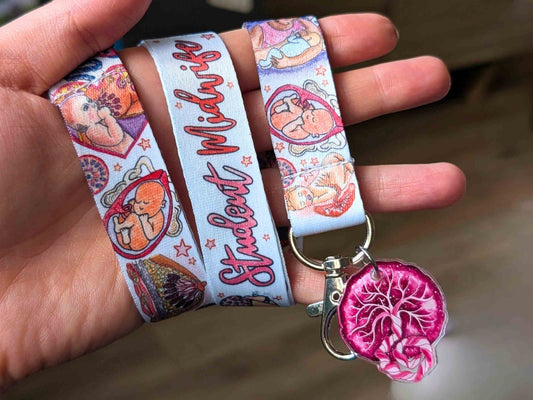
It's Not All Cuddling Babies: Realities of Student Midwife Life

From A-level hurdles to managing ADHD, navigating tough placement realities - first-year student midwife Lou shares an honest reflection on what training actually feels like, how she stays grounded, and why every student moves at their own pace.
Journey & Determination
Q. When did you first decide that you wanted to be a midwife, and what led to your decision?
When I was 15, I knew what I wanted to do. I was brought into this world through science and lots of love. My Mam brought me up independently after having me through IVF, and I appreciate the great peace and immense healing for her, which stemmed from receiving a daughter. Having her as an incredibly hard-working role model, I understood the tremendous positive impact new life can give to an individual.
From that point onwards, I knew I wanted to be part of something so beautiful and profound. There is something incredibly special about being involved in such an intimate and life-changing experience and knowing first-hand the impact that the arrival of a baby can have on a family makes me feel incredibly emotional and proud to be part of that journey.

Q. What did your journey look like to get accepted onto your course? When did you start?
I retook a year of sixth form after yr12, as I realised I was in a losing battle to plant/insect biology, despite exceeding in human anatomy for A-level biology. I decided to replace that with Criminology, psychology and drama. Luckily, my university of choice accepted psychology as a science when applying for midwifery.
I remember being incredibly nervous for my midwifery interview, particularly knowing how competitive the course was and how many people apply year after year in the hope of securing a place.
"During my interview, I made one thing very clear: I was going to become a midwife, no matter what it took."
I remember saying that, if I wasn't successful in gaining a place on the midwifery course, I would have completed Adult Nursing and then worked towards transitioning into midwifery or continuing to apply every year. Becoming a midwife was never something I was willing to give up on.
I think that determination was respected, and I was incredibly fortunate to initially be offered a place on the January 2026 cohort, then later received news I would be able to start on the September 2025 cohort. I made it.
After what felt like an endlessly long wait for results day, I opened my results to find that I had achieved two A grades and a B. At that moment, it finally felt real. I have secured my place and I will be a midwife.

Expectations vs Reality
Q. Before you started, what were the things about student midwife life that you expected to be 'aesthetic' or romanticised, versus what training actually feels like?
"Most people idolise the typical university day as effortless, polished and filled with cute stationary and note taking, with a cup of coffee to hand."
I underestimated the high demand of academics and placement. Coming straight from sixth form, I was used to a structured and linear teaching pattern, which definitely is not the case at university.
Especially in the first few months of first year, a high volume of content is pushed, to go out onto placement very shortly after starting. Knowing the high academic pressure now, I would’ve planned better to prevent being overloaded, which is why for year 2 I have a student midwife planner from The Student Midwife shop and have already started mapping out the year in it (one stress down, many more to go).

Another quick thing to mention, is the vast majority of people who I tell about being a STMW, believe I will always be surrounded by cute babies. When actually, you spend a huge amount of time caring for the mother, not just the baby. And a lot of that care isn't particularly glamorous.
There are blood pressures, urine samples, postnatal checks, breastfeeding support, lochia, perineal assessments, bowel movements, catheters, medication, paperwork and endless documentation.
"You quickly realise that midwifery is far more than delivering babies."
Q. What has been one of your absolute favourite 'high' moments so far in your training?
For the majority of student midwives, their ‘highest’ moment will’ve been delivering their first baby. My first delivery was very memorable and special, and definitely up there in my best moments so far, but my favourite will always be the first assisted delivery I was present for. She held my hand the whole time, and when the baby was delivered safely, she commended me on my amazing words of encouragement.
"She told me that I made her believe in herself, despite her not believing in herself."
I feel quite emotional writing this, as I will never forget this remarkable compliment, and will carry that with me for my entire career.
Q. What have been the real, unglamorous moments for you that people don't usually see on social media?
The academic side of the first term, I would explain like a game of cat and mouse. Lectures are very content heavy, and I would go home to get to grips within my own time, leaving me in a constant state of exhaustion. I felt like I couldn’t keep up, as by the time I wrapped my head around something, I was bombarded with more. It was truly isolating as my only thoughts were: ‘assignments’, ‘revision’, ‘clinical practise’, ‘strengthen your knowledge of what you’ve learnt today’.
I went completely radio silent on my non-midwifery friends, and the guilt I felt from that was immense. Luckily, my lovely group of girls from uni recognised this, before I genuinely went insane, they put me on a probation for doing work outside of university and on my breaks, which yes is funny, but I am very grateful for.
Equally, having my partner support me closely, my lovely Mam and my non-midwifery friends understanding the high demand, made life so much easier. Had I not had these amazing individuals to support, I probably wouldn’t have as much of an optimistic perspective on my university life.
"Comparing yourself to other student midwives can be an incredibly gruelling process, which is guaranteed to happen to everyone at some point."
For example, it can be difficult when you hear about someone else having more births, completing more proficiencies or feeling confident in an area that you are still developing in.
It is easy to focus on what others have achieved and overlook your own progress, particularly when every student has different placements, experiences and opportunities. I myself have achieved 3 births in first year, which I am so proud of, but it’s gut-wrenching to see that others are closer to the finish line.
Competition and relentless self-critique are a part of midwifery. I have a very strong group of girls, and we have established healthy communication about our progress, worries, happy memories and struggles, minus the factors of judgment, jealousy and stress. I think this is a very important dynamic to have as a STMW, so we can leave our troubles behind and become competent midwives.

Q. Do you think it’s concerning that students might go into their course not anticipating the lows and it would be better if they were more ‘prepared’? Or do you think that most people will be aware of how hard it’s going to be so students should put a positive spin on sharing so that the world can have more midwives-to-be?
I agree that most STMWs cannot anticipate the slumps that will happen throughout their studies, as well as throughout the entirety of their career. It’s important to know that this is completely normal.
Currently, I am in a very encouraging and clear mindset ready for 2nd year, but I fully expect to experience more rough patches.
"I have a spine tattoo of a moon cycle, as ‘like the moon, we must go through phases of emptiness, to feel full again’."
This means a lot to me because it can be applied to so many things, like academic life, feelings of doubt and imposter syndrome, or even things in maternity like parenthood itself. Although it’s a daunting feeling knowing there’s times of low ahead, knowing that it is a natural process is a comfort in itself.
Challenges & Improving Maternity Services
Q. What do you feel are the main challenges that make being a student midwife in the UK so hard?
Something I think makes being a UK student midwife more difficult, is the way midwifery is currently portrayed in the media. The media often brandishes midwives as a direct cause for the increased birth trauma.

Image from Sheena Bryon's blog post: Normal birth - a moral and ethical imperative
Whilst there are systemic failures in midwifery, the media can individualise these failures, and therefore overlook the pressure of long hours, emotional challenges, emergencies, documentation and responsibility that midwives endure.
I follow the ‘Fund Future Midwives’ campaign, who share the reality of the midwifery staffing crisis in England. This helps shed light on the burnout current midwives experience and the lack of job opportunities newly qualified midwives face.

I think this contrast between the romanticised image of midwifery and the reality of working within an overstretched maternity service, can make the transition into the profession particularly difficult for students, as we are often entering the course with passion and meaningful insight, and faced with negative connotations for being a midwife. The stress of job opportunities upon qualifying further increases this pressure.
Q. What do you think could be done to improve things? What would have made your journey better? And what do you wish you’d known when you started?
One area I think needs greater attention is the number of student and newly qualified midwives who can complete a three-year degree without being guaranteed a job in the profession they have trained for. This feels particularly contradictory when maternity services continue to experience staffing pressures.
Greater workforce planning between universities and NHS trusts could help ensure that the number of students being trained more closely reflects the future workforce requirements, whilst sufficient funding for substantive Band 5 posts would allow newly qualified midwives to enter the profession. After investing three years into training the next generation of midwives, it seems counterproductive to lose them at the point they qualify.
Whilst it can be frustrating to see the ongoing challenges within maternity services, I think it’s also important to recognise that meaningful change within maternity care can take time.
Improvements such as the Saving Babies' Lives Care Bundle, the development of continuity of carer and the expansion of specialist perinatal mental health services have developed over several years rather than producing immediate results. The reduction in stillbirth and neonatal mortality demonstrates that sustained investment, research, education and changes to clinical practice can have a positive impact.
So, although I would like to see quicker action regarding current issues such as staffing and employment for newly qualified midwives, I also recognise that lasting change within such a complex healthcare system cannot happen overnight.
"I wish I had known that pursuing my passion for celebrating pregnancy as a midwife would require patience, but ultimately, maintaining that fascination will be worthwhile when I see positive changes within maternity care in the long term."

Studying & Navigating Training with ADHD
Q. How do you feel your ADHD has both helped and hindered you in your course, on placement and with your cohort?
Thinking quickly in busy environments has allowed me to be focused, calm and proactive in emergency situations I have been present for. When there is a clear, immediate stressor, lots of ADHD individuals function more effectively.
"I have high sensitivity to other people's emotions. In midwifery, this helps me recognise when a woman is anxious, overwhelmed or needs additional reassurance (allowing me to support others in my cohort and mothers on placement)."
Combining this with my hyperfocus tendencies is a particular strength, I enjoy educating women about all the things that may be forgotten about in maternity care. For example, fun facts like the bumps around the areola release a moisture that smells like amniotic fluid to help encourage breastfeeding, or how talking to baby in-utero sends kinaesthetic waves improving blood flow in the cord, and the many forgotten about non-pharmacological pain relief methods, I could go on forever.
As I’ve mentioned, comparison to others is normal, however having ADHD sometimes makes it worse. Seeing another student seemingly remember everything, complete proficiencies quickly or appear confident can make you question your own ability, even though my progress and unique experiences is excellent, after reflection of all my feedback.

Q. How do you manage the balance of heavy uni work, lectures, and placement while navigating ADHD?
Honestly, my uni girls. One of those girls I was already close with before starting the course, so it was nice having this comfort going into something new. On my first day, I didn’t anticipate the traffic and was 15 minutes late, I sat next to my friend, who happened to be sitting with 3 other girls. We have all been inseparable ever since and will be forever grateful.

Another useful thing has been my TikTok platform. I post videos from time to time, whether it be about my actual uni experience, sharing useful things for student midwives and just having fun with my friends in general.
I’ve had lots of individuals reach out to me asking about the course and for advice, I’ve connected with student midwives at my uni who are in 2nd/3rd year, as well as connecting with lots of other student midwives in places like Australia. This has helped me feel less alone definitely, it’s a nice feeling that sharing my own experiences has helped others feel better, and I’m having fun whilst doing it.
Q. Do you have any specific routines, hacks, or tools that help keep you focused and stop you from feeling overwhelmed when the workload builds up?
ADHD and procrastination go hand in hand. My productivity 101 hack, specifically for assignments, is grabbing a big A3 sheet of paper for the assignment walk through lecture and making a detailing plan. Introductions, paragraph one, paragraph 2, analysis, strengths, which parts need research/references, conclusions: this is such a life saver for me.
I typically do one of these plans, continue with my other priorities or focus on my placement, and when it comes to 4-5 weeks before it’s due date I forget I’ve made it, so when I come to do it the job is practically already done.
Q. What would you say to an incoming or current neurodivergent student who might be feeling nervous about managing the academic side of the degree?
Please don't let that fear convince you that you aren't capable. Midwifery is an extremely hard and competitive course; you are here because you’ve worked hard
"If you’ve worked hard enough to get a spot on the course, then clearly you have what it takes to become an amazing midwife."
Q. Do you receive any additional support or accommodations as a student with ADHD? And if not, what do you wish you did have?
I receive disabled students’ allowance, where I have received equipment such as Loop switch ear plugs, voice recorder to transcript lecturers’ discussion (with their consent) and software that summarises/analyses things like research papers or textbooks. These have been a massive help.
The Loop switch plugs I wear in lectures, and I can switch the noise level for when things get too loud and overwhelming or have them in a setting where background noise is minimal and I can only hear my lecturer. The recorder and software also make life easier, as it sometimes feels daunting trying to constantly keep up and write what lecturers are saying, and makes big texts less intimidating.
Study & Placement Survival Essentials
Q. What are your top 3 non-negotiable items or study essentials that you rely on to get you through long study days or placement weeks?
Brain dump lists, I have random thoughts of important things at random times of the day, it’s important that you get it down on paper and out of your head, because trust me you will forget about it.
Pomodoro study timers, I use an app called ‘Flora’, where you can set a designated amount of time to study or focus, and at the end you grow a tree. If you come off the app to go on your phone and get distracted, it kills the tree. It sounds daft but I feel sad if I kill a tiny digital tree, so it’s so helpful having something like this to stay on track.
A good collection of water bottles, since having ADHD I find it hard to drink water a lot of the time, and when I get a new water bottle I drink tons. Then I get bored. So, I have a few nice water bottles that I have on rotation to keep me on my toes, because if I don’t drink water I lose focus and feel physically drained.

Q. How do you like to celebrate yourself when you finish a big essay, pass an assessment, or wrap up a tough block?
I celebrate with my uni girls, since we all are so busy, especially when on placement, we find it hard to spend quality time if we’re not on campus together.
I also tend to do a shopping spree… Using the fact I did well in an assignment as an excuse to buy yet another pair of pyjamas or clothes. Treats like this are still important though, it keeps the magic alive in a way, as I think I would burnout if I was simply passive to a good grade I achieved.
Q. If you could send a little message of reassurance to someone starting their midwifery journey who feels like "everyone else has it all together," what would you tell them?
Please remember that they probably don't. Starting midwifery is overwhelming, and it’s easy to look around at other students who seem confident, organised and assume that you're the only one struggling. You aren't.
Everyone learns at their own pace, and everyone's journey looks different. You don't need to know everything on your first day, or even your first year, you're there to learn.

I recently got one of the proficiency trackers from The Student Midwife Shop, and it shocked me actually seeing my progress right in front of me in such a cute format, making me realise how much I’d underestimated myself.
"Be kind to yourself, ask questions, make mistakes safely, celebrate the little wins and trust that, little by little, you will become the midwife you're meant to be."
Follow Lou's student midwife journey on TIktok!
Thank you so much to Lou for contributing her student midwife story - I'm sure that lots of Lou's words will resonate with other student midwives. If you have a story to tell, please let me know - I'd love to share it.