Student Midwife Starter Checklist: What to Buy for Uni, Placement & Home
Starting your midwifery degree or preparing for your clinical rotation can feel completely overwhelming!

To help you feel organised, excited, and proud - I have put together this UK student midwife starter checklist.
From surviving 12-hour hospital shifts to tracking your very first birth, this guide breaks down the essential gear you might want.
Short on time? Download the summary checklist here and read the full tips later Student Midwife Starter Shopping List
Tip: The "Wait & See" Strategy
Before you dive into a massive shopping spree, remember that every university and NHS Trust is different. Don't rush to buy all the textbooks on your reading list before your first lecture - many unis have extensive digital libraries, and your lecturers will tell you which ones are actually essential. Also, check for pre-loved groups for your university; senior students are often happy to pass on items like scrub tops or reference books, saving you money for the specific gear you know you’ll use daily.

Part 1: Ward & Clinical Placement Essentials
Hospital shifts move fast. NHS bare-below-the-elbows policies mean you need practical, compact gear that can be easily sanitised or stowed in your scrub pockets.
Ward Reference & Identification
When you're running between rooms, keeping your ID secure is crucial. You will want Student Midwife Lanyards or Badge Reels to keep your ID visible. Some Trusts don't allow lanyards at all, and some will allow them if they have multiple safety breaks - but even if you can't wear on shift, you could still use for uni - or just to keep your keys easy to find!

Image: Student Midwife lanyard with maternity illustrations
Tip: Check Your Local Policy
Before buying any clinical equipment, take a look at your specific Trust’s uniform and equipment policy. Rules vary a lot. Knowing the rules before you turn up on day one saves you stress and ensures you’re fully compliant from the start and you won't waste any money.
To survive medical handovers, slip some Maternity Abbreviations Cards behind your ID card or in your folder for quick clinical definitions on the move. Be aware that abbreviations can differ from Trust to Trust, so only use cards like these as a decoding guide - rather than an official list of abbreviations you should use when writing notes yourself.

Image: Student Midwife abbreviations cards
Quick Pocket Notes
You can never have enough stationery on a hectic ward floor. Keep compact Pocket Notepads or handy Tear-Off Observation Notepads tucked safely in your pockets to scribble down vitals, door codes, and phone numbers.

Make sure to stock up on reliable Student Midwife Pens - always carry black ink, as blue ink does not always photocopy cleanly on official NHS records!
Shift Survival Gear
While I can help with administrative and reference gear, your body will need a few extra tools to survive a 13-hour shift:
- Supportive Footwear: Invest heavily in high-quality, fluid-resistant shoes (like Crocs Work or Toffeln) that are comfortable enough for long walks and approved for operating theatres.
- A Reliable Fob Watch: Wristwatches are strictly banned on clinical floors. Buy a high-visibility, silicone fob watch with a distinct second hand for manual heart rate monitoring and contraction counting.
- Compression Socks: Standing for long stretches can wreak havoc on your legs. Pick up a few pairs of graduation compression tights or socks to prevent fatigue and swelling.
- The Stethoscope: While you will definitely use one, you don't need to rush out and buy a top-of-the-range model on day one. Some Trusts provide them, and you may find you use a handheld Doppler or pinard more often in certain settings. If you do choose to buy one, look for a reliable, mid-range "all-rounder" (like a Littmann Classic III) and always have your name clearly engraved on it - clinical gear has a funny habit of walking off in busy hospital corridors!
- The Tourniquet: Many students prefer their own material tourniquet because they find the single-use ones provided by the hospital uncomfortable or difficult to secure on tricky veins. However, always check your Trust’s infection control policy first. Some areas are very strict about only using provided single-use equipment to prevent cross-contamination. If personal ones are allowed, keep yours in a small, wipeable pouch to ensure it stays clean and compliant with "bare below the elbows" standards.
Tip: The "Ward-Ready" Bag Checklist
Your placement bag is going to go through a lot - from being tucked under a desk in a lecture hall to sitting on a clean-room floor or in a staff locker. When you’re choosing a bag, don’t just look for style; look for these three "work-ready" features:
- Wipeable Materials: Hospital environments are not kind to fabric bags. Look for high-quality, water-resistant, or wipeable fabrics. If it can’t be cleaned quickly with a sanitising wipe, it’s going to get grotty very fast.
- Security & Accessibility: You need to be able to reach your essentials - ID, pens, keys- without dumping the entire contents of your bag on the floor. Internal pockets or separate compartments are non-negotiable for staying organised during a chaotic shift.
- "Sealable" Protection: If you’re carrying a laptop or heavy lecture notes, ensure your bag has a secure zip or closure. You will be moving quickly, and you don’t want your stationery or snacks taking a tumble in a busy corridor.

Part 2: Tracking Milestones & Birth Documentation
Documenting your clinical experiences is a mandatory element of the Nursing and Midwifery Council (NMC) training regulations.
Tip: Mix Your Tech
While physical reference cards are great for quick, off-the-cuff memory prompts on the ward, don't ignore your digital toolkit. Apps like Complete Anatomy or reliable drug calculation tools are fantastic for deeper study. Think of your kit as a hybrid: keep your physical notes for quick-access ward floor speed, and your apps for when you have a moment to deep-dive into the physiology behind a procedure.
Documenting Your Catch Numbers
To track your required clinical competencies (including antenatal, postnatal, and neonatal milestones), you can use a PERs Tracker Booklet.
You will likely see a lot of printed "Pocket MORAs" on offer and many students swear by them to quickly check off their Nursing and Midwifery Council (NMC) proficiencies on shift.
However, the NMC has explicitly stated that unofficial pocket MORAs should not be used as formal assessment records on placement. Additionally, copying the exact, full official proficiencies into commercial notebooks can breach copyright laws - so that's why I decided I'd be better not to make one!

Image: PERs tracker booklet
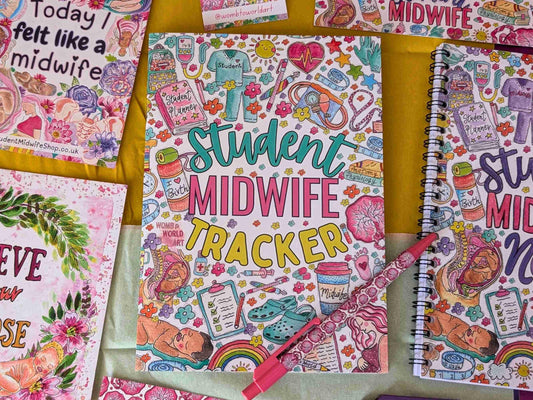
Relying on them as your primary grading logging sheet could put your placement compliance at risk. You still need a way to keep track of your core figures without violating university or NMC rules so I designed my PERs Tracker Booklet to help make this easier and give you a tracking tool that lets you colour in and count your core target numbers (like your 100 antenatal exams or 40 births). It keeps you highly organised at home or on campus, keeping you compliant with official electronic MORA logging requirements on shift.

Image: First 40 Births Reflective Log Book
To preserve the emotional memory of your training milestones, log your personal journey in a 40 Births Reflective Logbook - and for honouring your next 960 births you can go for a hardback Birth Record Book as a keepsake, which I made to give you a special space to remember all the lives you've touched in your career as a midwife.

Image: Hardback Birth Record Book
Celebrating Success
Midwifery training is a marathon. Celebrate reaching your target numbers visually back home using Birth Counter Prints and Stickers.
You can also document your achievements with a Student Midwife Milestones Card Deck for social updates, or take a peaceful mental break after a tough block using a Milestones Colouring Book.

Image: Ultimate Student Midwife Milestones Card Deck

Part 3: University Lectures & Academic Planning
Balancing complex placement block rotations with essay deadlines and heavy university lecture modules requires elite level scheduling. Setting up a dedicated, visually inspiring desk space isn't just great for your mental focus - it's a massive milestone that many midwifery students love to share and celebrate on social media!

Image: Student Midwife September 2026 Planner
For on-the-go scheduling between campus lectures and hospital shifts, carry a Student Midwife Planner Notebooks. They are perfectly structured to keep your busy academic calendar completely aligned with your clinical shift patterns.
Tip: Managing the "Imposter Syndrome" Wave
It’s easy to feel like you need the perfect desk setup to be a successful student, but don't let the pressure to have everything perfectly curated lead to burnout before you've even started. Your desk space should be a place that brings you calm, not a source of extra admin. Start with the basics, and add your decor as you hit your own personal milestones - it makes celebrating those achievements feel even more rewarding!
Desk Organisation & Time Management
To create the ultimate study space of dreams at home, start by decorating your walls with my beautifully illustrated pregnancy and birth art Poster Bundles and birth art prints, providing visual references while making your study space look inspiring!
Map out your rotation calendars, exam blocks, and assignment deadlines alongside them using my massive A1 and A2 September and Undated Wall Planners directly on your study wall. They come with dot stickers and a key, so you can use them to mark out when you're on shift/at uni/on holiday, and there is space to track your assignments and placements.

Image: Student Midwife wall planner, available in A1 and A2, undated and September 2026
Keep your daily tasks perfectly aligned right at your fingertips using desk-bound items. A Weekly Desk Planner and quick-tear Checklist To-Do Pads are perfect for mapping out daily priorities and what you want to get signed off that week.

Image: Student Midwife weekly desk planner pad
Complete the desk look by pairing them with a Mouse Mat and some Student Midwife laptop stickers to brighten up your workspace.

Image: Womb to World Art laptop stickers, mouse mat and notebook
Keeping Lecture Revision Aesthetic
Ditch the boring, plain supermarket binders! Keep your complex university lecture notes cleanly structured using Student Midwife Notebooks.

Image: Student Midwife A4 Notebook with Undated Planner and Pencil Case
To keep your lecture desk clutter-free, pack your highlighters, stationery, and sticky notes inside my matching waterproof Wash Bags and Cosmetic Bags/Pencil Cases featuring my midwife art - they are brilliant for protecting your things from accidental leaks in your university bag.

Image: Student Midwife Bag, Pencil Case and Lanyard
Finally, make sure you have a comfortable spot to sit with a Placement Reflections Journal so you can write up your field notes for your university portfolio submission immediately after shifts. I've made an A5 version for you to keep in your bag on placement, and a bigger A4 one to keep at home for end-of-the day reflections.

Image: Student Midwife Placement Reflections Journals in A4 and A5
Campus & Desk Preparation
To completely finish your university prep and desk transformation, consider adding these highly recommended student study essentials:
- Ergonomic Desk Lighting: Hospital wards are blindingly bright, but your late-night study desk should be calming. Grab a dimmable, warm desk lamp to reduce eye strain during late-night essay writing.
- A Durable Water Bottle: Wards and university lecture theatres get incredibly hot. Carry a heavy-duty, insulated water bottle to maintain your hydration levels while you revise or sit through long lectures.
- Quick Energy Snacks: Keep a small snack tray or emergency high-protein bars tucked away in your university bag or desk drawer to fuel you through long, dense anatomy, physiology, or pharmacology blocks.
Tip: The "12-Hour" Bento Kit
On a 12-hour shift, you often don't get a proper lunch break, and hospital canteen options aren't always great for sustained energy. Investing in a leak-proof, high-quality bento box or a decent thermal food flask is a game-changer. Being able to access a nutritious, high-protein meal at 3:00 AM that is still at the right temperature is one of the best ways to protect your energy levels and avoid the "sugar crash" that comes from relying on vending machines.
Download a PDF checklist here to print - Student Midwife Starter Shopping List

More questions
What's the one thing I shouldn't skip buying before placement starts?
Footwear. Everything else on a kit list can be sorted out in the first week or two, but you don't want to be stood in unsuitable shoes on your very first 12-hour shift. Fluid-resistant, theatre-approved shoes like Crocs Work or Toffeln are worth getting sorted in advance.
Do I need to buy a fob watch before my first placement? Yes, this is one to have ready on day one rather than leaving until you're already on the ward, since wristwatches aren't allowed on clinical floors and you'll need a way to count contractions and monitor heart rates from the start.
Should I buy reference cards before I understand the abbreviations, or will they make more sense later?
They're actually most useful right at the start, before the terminology feels familiar, since that's when you're most likely to be caught out in a handover. Just keep in mind they're a decoding guide for what you'll hear, not an official list to write your own notes with, since abbreviations vary by Trust.
Is it worth buying a proper tracker or logbook, or can I just use a notebook?
A plain notebook works, but a dedicated tracker designed around your NMC milestones (antenatal exams, births, postnatal checks) is a lot easier to keep consistent and satisfying to fill in over three years. It's also worth keeping separate from your official electronic MORA log rather than instead of it.
What stationery is actually worth buying versus what can wait?
Black pens are worth getting right away, since blue ink doesn't photocopy cleanly on NHS records and you don't want to be caught out. Bulkier things like binders or a full notebook set can wait until you know your course structure and whether digital or paper notes suit you better.
Should I buy a stethoscope before I start, or wait?
Some Trusts provide one, and you'll likely use a Doppler or pinard in a lot of settings anyway. It's worth holding off any big spend here until you know what you actually reach for day to day.